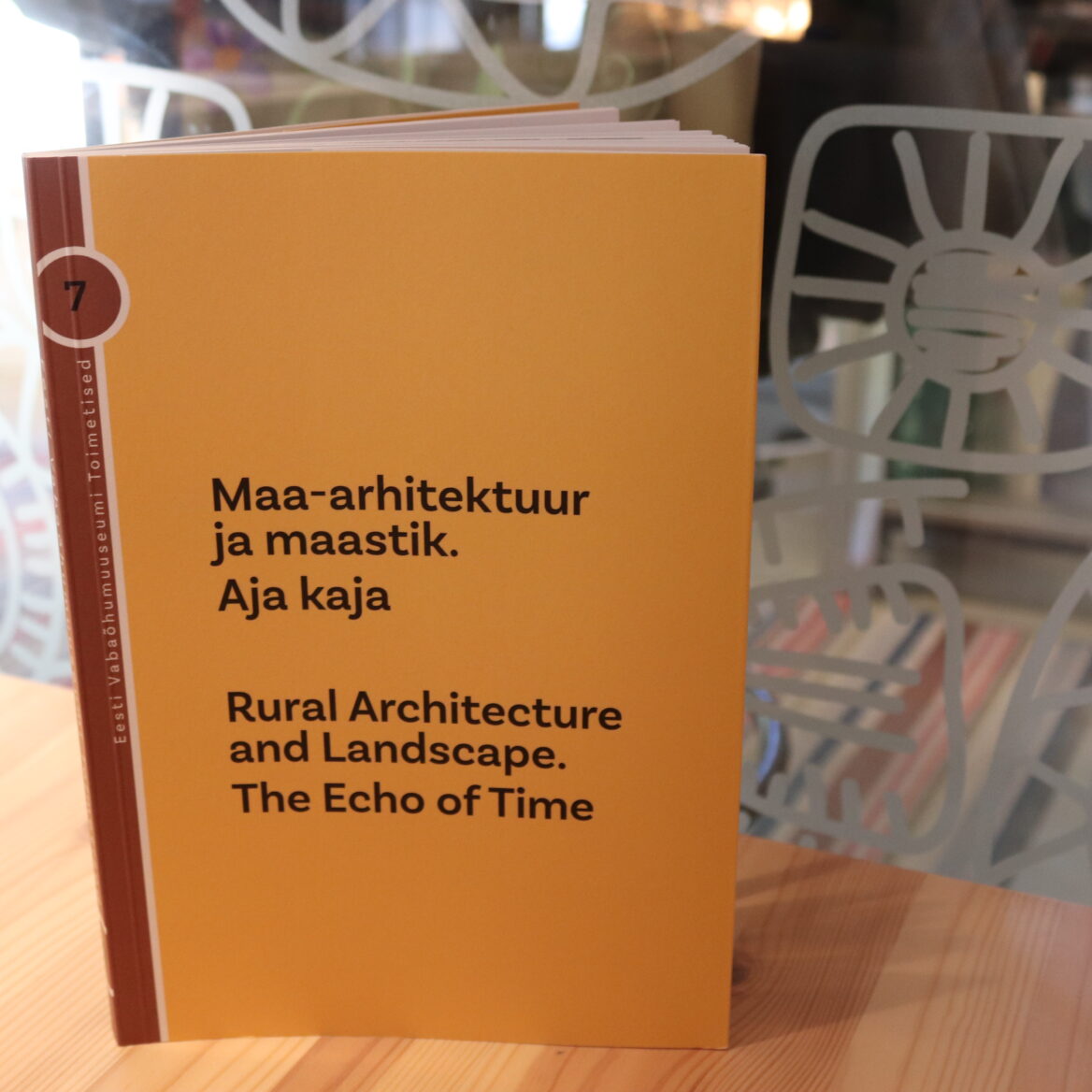
EVM Publications 7 “Land Architecture and Landscape: A Chronicle”
12.00 €
In the articles of the seventh volume of the Estonian Open-Air Museum’s series *Maa-arhitektuur ja maastik. Ajakaja* (Rural Architecture and Landscape: A Chronicle), museum researchers and other scholars explore various aspects of the history of Estonian architecture and construction. Illustrated with numerous photographs, the collection examines the life and work of Peeter Matz, the founder of Estonia’s first fireproof clay industry; provides a fascinating look back at a little-known aspect of town halls—detention cells—and the colorful court cases associated with them, and examines pre-war wooden architecture outside of Tallinn.
The spotlight is on several notable buildings, such as architect Herbert Johanson’s “weekend home,” the Kibuvitsa farmstead in the Õismäe neighborhood of Tallinn (now demolished), the Raikküla Ministry School building, Estonia’s first town hall in Vana-Kuuste, and the Univere farmstead in Tartu County—the latter is made special by a construction contract dating back to 1906.
In an interview, Fredi Tomps, the legendary restoration architect who turns 95 this year, takes us on a trip down memory lane to the early years of the open-air museum’s exhibition.
The data controller for the personal data collected by the Estonian Open Air Museum Foundation’s handicrafts e-store and the Kolu Tavern catering e-store is the Estonian Open Air Museum Foundation (registration code 90012585), located at Vabaõhumuuseumi tee 12, Tallinn 13521, tel. +372 6549 100, and email .
What personal data is processed?
− name, phone number, and email address;
− the delivery address;
− bank account number;
− the cost of goods and services and payment-related information (purchase history);
− customer support information.
For what purpose is personal data processed?
Personal data is used to manage customer orders and deliver goods. Purchase history data (purchase date, item, quantity, customer information) is used to compile an overview of purchased goods and services and to analyze customer preferences. Bank account numbers are used to issue refunds to customers. Personal data such as email address, phone number, and customer name are processed to resolve issues related to the provision of goods and services (customer support). The IP address or other network identifiers of online store users are processed to provide the online store as an information society service and to compile web usage statistics.
Legal Basis
Personal data is processed for the purpose of fulfilling the contract entered into with the customer. Personal data is processed to comply with a legal obligation (e.g., accounting and the resolution of consumer disputes).
Recipients to whom personal data is disclosed
Personal data is shared with the online store’s customer support team to manage purchases and purchase history and to resolve customer issues. The customer’s name, phone number, and email address are shared with the shipping provider selected by the customer. If the goods are to be delivered by courier, the customer’s address is also provided in addition to their contact information. If the online store’s accounting is handled by a service provider, personal data will be transferred to that service provider for the purpose of performing accounting operations. Personal data may be transferred to information technology service providers if necessary to ensure the functionality of the online store or data hosting.
Security and Data Access
Personal data is stored on the servers of SA Eesti Vabaõhumuuseum, which are located within the territory of a European Union member state or a country that is part of the European Economic Area. Access to personal data is granted to online store employees, who may view personal data in order to resolve technical issues related to the use of the online store and to provide customer support. The online store implements appropriate physical, organizational, and IT security measures to protect personal data against accidental or unlawful destruction, loss, alteration, or unauthorized access and disclosure. The transfer of personal data to the online store’s authorized processors (e.g., shipping service providers and data hosting providers) is carried out on the basis of agreements concluded between the online store and the authorized processors. Authorized processors are required to ensure appropriate safeguards when processing personal data.
Accessing and Correcting Personal Data
You can view and edit your personal information in your online store user profile. If you made a purchase without creating a user account, you can view your personal information through customer support.
Withdrawal of Consent
If the processing of personal data is based on the customer’s consent, the customer has the right to withdraw that consent by notifying customer support via email at .
Storage
When a customer account in the online store is closed, personal data is deleted, unless such data needs to be retained for accounting purposes or to resolve consumer disputes. If a purchase is made in the online store without a customer account, the purchase history is retained for three years. In the event of disputes related to payments or consumer disputes, personal data will be retained until the claim is resolved or the statute of limitations expires. Personal data required for accounting purposes will be retained for seven years.
Deletion
To have your personal data deleted, please contact customer support via email at . We will respond to your deletion request within one month at the latest and specify the timeframe for deleting the data.
Direct Marketing Notices
The email address and phone number are used to send direct marketing messages if the customer has given their consent. If a customer does not wish to receive direct marketing messages, they should click the appropriate link in the email footer or contact customer support. When personal data is processed for direct marketing purposes (profiling), the customer has the right to object at any time to both the initial and further processing of their personal data, including profiling related to direct marketing, by notifying customer support via email (such information must be provided clearly and separately from any other information).
Dispute Resolution
Disputes related to the processing of personal data are resolved through customer support (SA Eesti Vabaõhumuuseum, tel. +372 6549 100 and email ).
The supervisory authority is the Estonian Data Protection Inspectorate ().
SA Eesti Vabaõhumuuseum is the controller of personal data and transfers the personal data necessary for processing payments to the authorized processor, Montonio OÜ.
Terms and Conditions of the Estonian Open Air Museum Foundation’s Online Store
1. General Provisions
1.1 These Terms and Conditions of Sale govern the purchase of products from the SA Eesti Vabaõhumuuseum online store at pood.evm.ee.
1.2 The Seller is:
Estonian Open-Air Museum Foundation Registration Code: 90012585 KMKR No.: EE101690995 Address: Vabaõhumuuseumi tee 12, 13521 Tallinn, Estonia Country of Location: Estonia Phone: +372 654 9100 Email:
1.3 The online store sells museum-related publications, handmade items, souvenirs, and other goods. The online store also sells digital products.
1.4 The sales contract takes effect once the buyer has paid for the order.
2. Placing an Order
2.1 The buyer adds the desired products to the shopping cart.
2.2 Before confirming the order, the buyer can review and modify the order details.
2.3 By placing an order, the buyer confirms that the information provided is accurate.
2.4 Orders can be placed in Estonian and English.
3. Prices and Payment
3.1 All prices are in euros and include VAT.
3.2 You can pay for your order:
· via bank transfer;
· With a Mastercard;
· With a Visa card.
3.3 Payments are processed by the Estonian Open Air Museum’s contracted payment service provider. After the payment is made, the buyer is redirected back to the online store.
4. Receiving the Order
Physical products
4.1 The delivery options for physical products are displayed during checkout.
4.2 Physical products are generally shipped within 2–7 business days, unless otherwise specified for the product.
4.3 If the ordered product cannot be delivered, the seller will contact the buyer.
Digital product
4.4 A digital voucher confirming the purchase of a digital product sold in the Estonian Open Air Museum’s online store will be sent to the email address provided by the buyer when placing the order, following successful receipt of payment. The electronic voucher is a digital product and will not be issued in paper form.
4.5 Typically, a digital voucher is sent to the buyer’s email address on the same day, usually within a few minutes after the payment has been successfully processed. If you haven’t received the voucher within an hour, please check your spam folder or contact customer support at .
5. Right of Withdrawal
5.1 A purchaser of a physical product has the right to withdraw from the contract within 14 calendar days of receiving the goods.
5.2 Returned merchandise must be unused and undamaged, except to the extent necessary to inspect the merchandise. 5.3 To return merchandise, please contact us at .
5.4 A refund will be issued no later than 14 days after receipt of the returned merchandise.
5.5 In the case of a digital product, the 14-day right of withdrawal does not apply if the digital voucher has been delivered to the buyer and the provision of the service has begun with the buyer’s prior consent, in accordance with applicable laws.
6. Filing Claims
6.1 The buyer has the right to file a complaint regarding a defective product in accordance with the laws of the Republic of Estonia. 6.2 Complaints must be sent to .
6.3 In your claim, please describe the defect and include the order number.
6.4 A response to a claim will be provided within a reasonable time, but no later than 15 days.
6.5 The Seller shall not be liable for any breach of its obligations if such breach is caused by force majeure.
7. Processing of Personal Data
7.1 The Buyer’s personal data is used to fulfill the order and to comply with legal obligations.
7.2 The processing of personal data is carried out in accordance with the privacy policy of SA Eesti Vabaõhumuuseum.
8. Liability
8.1 The Seller shall not be liable for any damages resulting from contact information incorrectly entered by the Buyer.
8.2 The Seller is not liable for delays caused by disruptions on the part of a payment service provider or a transportation service provider.
9. Dispute Resolution
9.1 The buyer and seller shall resolve disputes primarily through negotiation.
9.2 If no agreement is reached, the buyer has the right to appeal to the Consumer Disputes Commission operating under the Consumer Protection and Technical Regulatory Authority or to file a lawsuit in court.
10. Changes to the Terms and Conditions of Sale
10.1 The Estonian Open-Air Museum Foundation has the right to amend the terms and conditions of sale.
10.2 The terms and conditions of sale published in the online store are valid at the time the order is placed.